


“Train people well enough so they can leave. Treat them well enough so they don’t want to.”
– Richard Branson
In an era where organisations are investing heavily in technology, automation, and digital transformation, one truth remains constant: people are still the driving force behind business success. No matter how sophisticated the systems or how ambitious the strategy, organisational performance ultimately depends on the capabilities of the people responsible for delivering results.
Yet many organisations continue to face challenges that technology alone cannot solve: declining productivity, ineffective leadership, skills gaps, poor collaboration, disengaged employees, and increasing staff turnover. These issues not only affect workplace culture but also have a direct impact on profitability, customer satisfaction, innovation, and long-term growth.
The reality is that no organisation can consistently achieve exceptional results without investing in its people.
Why People Development Matters More Than Ever
Today’s workplace is evolving rapidly. Employees are required to adapt to changing business environments, navigate diverse teams, communicate effectively, deliver excellent customer experiences, and remain productive in increasingly demanding roles.
However, many organisations are discovering that technical expertise alone is no longer sufficient. Employees need a combination of professional, interpersonal, and leadership skills to thrive and contribute meaningfully to organisational success.
This is why people development, workforce training, leadership development, and employee capacity building have become strategic priorities for high-performing organisations. Companies that invest in developing their workforce often benefit from improved productivity, stronger employee engagement, better retention rates, and enhanced organisational performance.
Building High-Performing Employees Through Training and Capacity Building
One of the biggest barriers to organisational growth is a workforce that is not adequately equipped for evolving business demands. Employees who lack communication skills, customer service excellence, emotional intelligence, or professional workplace competencies often struggle to maximise their potential.
Effective training and capacity-building programmes help bridge these skills gaps by equipping employees with practical tools they need to perform confidently and effectively. From improving workplace communication and professionalism to enhancing productivity and accountability, continuous learning creates a more competent, confident, and high-performing workforce.
Organisations that prioritise employee development are better positioned to respond to change, improve service delivery, and maintain a competitive advantage.
The Link Between Strong Leadership and Business Performance
Research and experience consistently show that employees rarely leave organisations; more often, they leave poor leadership.
Many organisations promote top-performing employees into management roles without providing the leadership skills required to manage people effectively. As a result, teams experience reduced engagement, low morale, poor communication, and a lack of accountability.
This is where leadership training and performance development programmes become invaluable.
Strong leaders inspire teams, manage change, build trust, resolve conflict, and create cultures where excellence can thrive. By investing in leadership development, organisations equip managers and executives with the skills required to drive performance, improve employee engagement, and achieve strategic objectives.
Simply put, stronger leaders create stronger organisations.
Preparing Graduates for Workplace Success
Another challenge facing organisations today is the growing gap between academic qualifications and workplace readiness.
While many graduates possess strong educational backgrounds, employers often report deficiencies in communication skills, professionalism, workplace etiquette, emotional intelligence, and business awareness. These gaps can increase onboarding costs and delay productivity.
A structured graduate trainee programme helps bridge this gap by preparing young professionals for the realities of the modern workplace. By developing employability skills, professional confidence, workplace ethics, and business communication capabilities, organisations can build a reliable pipeline of future talent and leadership.
Investing in graduate development is not just about recruitment; it is about creating a sustainable talent strategy for long-term success.
Why Team Bonding Is Essential for Organisational Success
Even the most talented employees can struggle to perform when teamwork is weak.
Many organisations experience productivity challenges because departments operate in silos, communication is inconsistent, and trust among team members is lacking. These issues often result in workplace conflict, delayed projects, poor collaboration, and reduced innovation.
Effective team bonding retreats provide opportunities for employees to strengthen relationships, improve communication, build trust, and align around shared organisational goals.
When teams work together effectively, organisations become more agile, collaborative, and resilient. Strong workplace relationships create an environment where employees feel connected, valued, and motivated to contribute their best work.
The Competitive Advantage of Investing in People
The organisations that consistently outperform their competitors understand a simple but powerful principle: people are the foundation of sustainable growth.
- Productivity improves when employees are skilled.
- Performance improves when leaders are effective.
- Succession planning improves when graduates are properly developed.
- Collaboration improves when teams trust one another.
These are not isolated initiatives. They are interconnected elements of a thriving organisation.
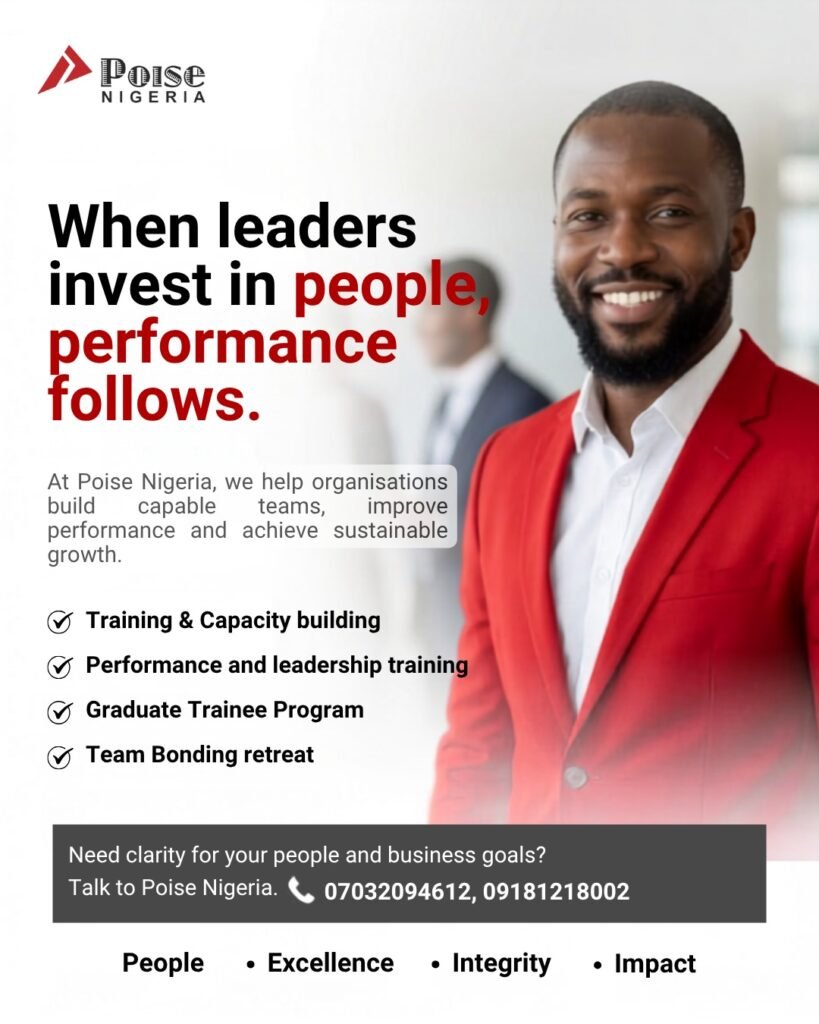
At Poise Nigeria, we help organisations build capable workforces through training and capacity building, performance and leadership training, graduate trainee programmes, and team bonding retreats. Our solutions are designed to address real workplace challenges, strengthen organisational capability, and drive measurable business results.
Because when organisations invest intentionally in their people, they are not just developing employees; they are building stronger leaders, more cohesive teams, healthier workplace cultures, and more sustainable businesses.
When leaders invest in people, performance follows.