

Employers rarely agree on everything. However, when it comes to the skills they want from professionals, the evidence is surprisingly consistent.
The World Economic Forum’s Future of Jobs Report 2025, based on a survey of employers worldwide, ranks the skills organisations rely on today and those expected to grow fastest by 2030.
The message is clear: professionals who thrive will combine sharp thinking with strong people skills and the confidence to work alongside technology.
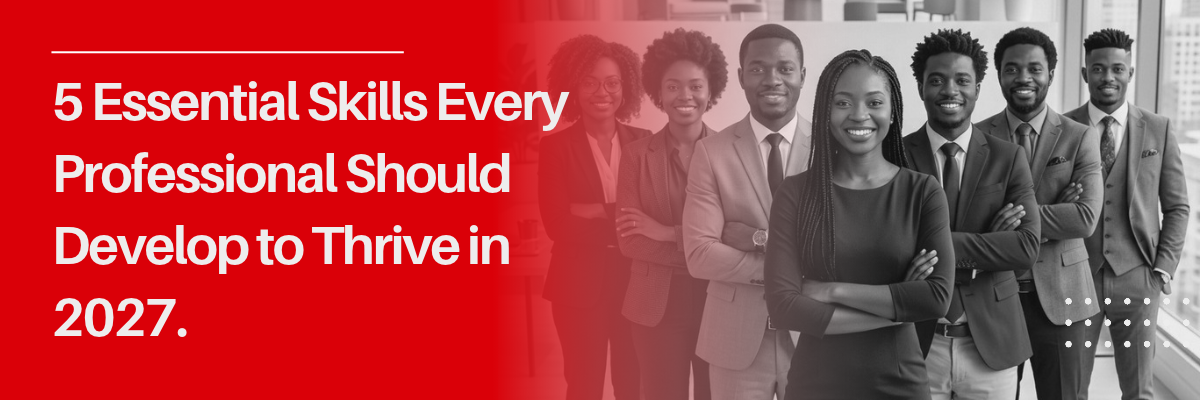
We reviewed the findings and identified five skills that score highly in both areas. Start building them now, and you will be better prepared for 2027 and beyond.
Why These Skills Matter
Workplaces are changing faster than ever. Technology continues to reshape how work gets done, while employers increasingly value professionals who can solve problems, adapt to change, and collaborate effectively. As a result, developing the right mix of technical and human skills has become essential for career success.
1. Analytical Thinking: Solving Problems Effectively
Analytical thinking remains one of the most important and sought-after skills in today’s professional environment. According to the report, 69% of employers consider it a core skill.
People with strong analytical skills break down complex problems, question assumptions, and make decisions based on evidence rather than instinct. Whether you are managing a project, resolving a customer complaint, interpreting business data, or developing a strategy, analytical thinking helps you understand a challenge before attempting to solve it.
As a result, professionals who think analytically are better equipped to make sound decisions and contribute meaningfully to organisational growth.
2. Leadership and Social Influence: Inspiring Others to Achieve More
Leadership is no longer limited to people in managerial positions. Instead, every professional has opportunities to demonstrate leadership through initiative, accountability, communication, and the ability to influence others positively.
Today, employers want people who can guide a team, persuade a sceptical client, and help others navigate change successfully. In addition, strong social influence allows professionals to build trust and encourage action without relying solely on authority.
This skill is developed through everyday interactions. For example, how you run meetings, provide feedback, take responsibility when things go wrong, and support colleagues can all strengthen your influence.
3. Creative Thinking: Finding Innovative Solutions
In an increasingly competitive business environment, organisations need professionals who can identify opportunities, challenge outdated processes, and offer fresh perspectives.
Contrary to popular belief, creativity is not reserved for designers, artists, or marketing professionals. It is valuable across industries and job functions. As routine tasks become easier to automate, the ability to generate new ideas, see different possibilities, and solve problems without a ready-made template becomes even more important.
To strengthen this skill, stay curious, seek diverse perspectives, and regularly challenge conventional ways of thinking.
4. Empathy and Active Listening: Building Strong Professional Relationships
In workplaces where collaboration is essential, the ability to understand and listen to others is invaluable.
Technology can process information efficiently. However, it cannot make a nervous client feel heard or help a struggling teammate feel understood. Empathy involves recognising and considering another person’s feelings, experiences, and perspectives. Active listening, meanwhile, requires giving someone your full attention and making a genuine effort to understand their message.
Together, these skills build the trust that helps teams perform better, strengthens client relationships, and makes difficult conversations more productive.
Consequently, professionals who combine empathy with active listening will be well positioned to foster collaboration and create positive workplace experiences in 2027 and beyond.
5. Technological Literacy: Navigating the Digital Workplace
Finally, technological literacy is becoming increasingly important. In fact, AI and big data represent the fastest-growing skill category in the report.
Technological literacy refers to the ability to understand, use, and adapt to digital tools relevant to one’s work. As organisations rely more heavily on digital platforms, automation, data systems, and artificial intelligence, professionals need confidence using technology to improve productivity and solve problems.
Importantly, technological literacy involves more than simply operating a computer. It includes choosing the right tools, navigating digital workflows, understanding basic cybersecurity and data practices, and using emerging technologies responsibly.
Furthermore, a technologically literate professional can quickly learn new systems and identify opportunities to work more efficiently.
According to the report, only about half of employers (51%) currently consider technological literacy a core skill. Therefore, there is still an opportunity for professionals to gain a competitive advantage in this area.
Curiosity, consistent practice, and continuous learning can help individuals keep pace with digital change and remain effective in evolving workplaces.
Build These Skills Before 2027
None of these skills develops overnight. Likewise, none is mastered through reading alone.
Instead, they grow through guided practice, honest feedback, and interaction with people facing similar challenges. That is exactly what Poise’s open programmes are designed to provide.
Join us this November and December:
1. Business Etiquette in the Corporate World (BECW)
Date: November 10–11 | Duration: 2 Days | Fee: ₦250,000
2. Indispensable Executive Assistant (IEA)
Date: November 11–12 | Duration: 2 Days | Fee: ₦250,000
3. Sales Leadership: Strategies of High-Performing Sales Managers
Date: November 26–27 | Duration: 2 Days | Fee: ₦300,000
4. Leadership, People Management & Business Communication
Date: December 1–3 | Duration: 3 Days | Fee: ₦300,000
5. The Art of Presenting and Public Speaking
Date: December 3–4 | Duration: 2 Days | Fee: ₦250,000
Register here: https://bit.ly/Poiseopenprogrammes
Choose the programme that best fits your career stage and development goals.
The professionals who start building these skills today are likely to be the ones employers seek in 2027.
Source: World Economic Forum, Future of Jobs Report 2025.