

Training Needs Analysis for Organizational Productivity has become increasingly important as organizations face mounting pressure to improve efficiency, customer satisfaction, and business performance. While organizational underperformance is often attributed to low employee engagement or weak accountability systems, the underlying issue is frequently an unaddressed skills gap.
Research consistently shows that when employee capabilities fail to match evolving job requirements, organizations experience delayed projects, operational inefficiencies, declining service quality, and reduced profitability.
This article examines the measurable impact of skills gaps on productivity and service delivery and explains how executive leaders and HR professionals can leverage Poise Nigeria’s free Training Needs Analysis (TNA) session to identify capability gaps and improve organizational performance.
1. Training Needs Analysis for Organizational Productivity: Understanding the Cost of Skills Gaps
Skills gaps impose a continuous, measurable levy on corporate output. Rather than manifesting as sudden operational halts, capability shortages act as a persistent drain on employee time, slowing down core business processes and inflating project schedules.
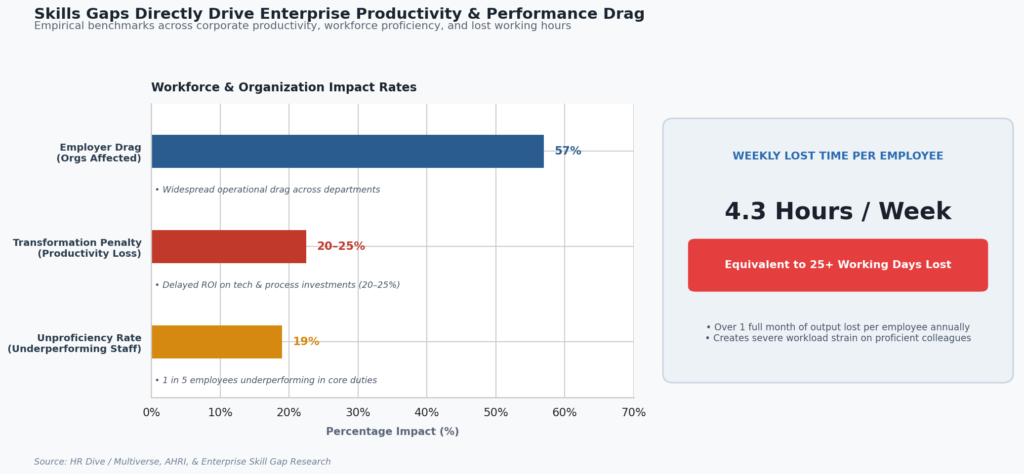
Research conducted by Multiverse across 18 industries reveals that capability gaps consume an average of 4.3 hours per employee per week. Over the course of an operational year, this waste accumulates to more than 25 working days—effectively a full month of lost productivity per worker annually. For an enterprise employing 500 knowledge workers, this equates to thousands of unbilled, unproductive hours lost to basic operational friction.
Data Task Efficiency Breakdown
- Total Weekly Allocation : Employees spend an average of 14.3 hours per week on data-related tasks.
- Productive Execution : 10 hours yield functional work output.
- Wasted Capacity : 4.3 hours are lost due to a lack of proficiency in tools, automation, and analysis—representing a 30% inefficiency rate.
Surveys by the Australian Human Resources Institute (AHRI) and the OECD demonstrate the breadth of this challenge, with 57% of enterprise employers reporting that skills gaps actively hamper organizational productivity.
Furthermore, nearly 1 in 5 workers (19%) are classified by their managers as not fully proficient in their present roles.
The financial and operational implications deepen significantly during periods of business transformation.
McKinsey research indicates that when organizations implement digital tools or operational shifts without corresponding skill upgrades, role productivity drops by 20% to 25%.
2. Training Needs Analysis for Organizational Productivity and Service Delivery Excellence
While lost working hours impact internal efficiency, skills gaps equally degrade client-facing operations. When employees lack proficiency in core technical, analytical, or communication competencies, service delivery quality declines, driving up operating costs and damaging brand equity.
Data from the OECD and Canadian Workplace Skills surveys identify technical skill shortages (57%), problem-solving deficits (49%), and customer service skill gaps (35%) as primary catalysts for operational friction.
These capability deficits trigger two primary structural penalties across enterprise operations:
- Escalated Operating Costs : 39% of organizations experience elevated operating expenses directly tied to worker skill deficits. Under-skilled staff take longer to execute routine procedures, require higher supervision ratios, and make frequent errors that necessitate costly rework.
- Workload Strain on Proficient Employees : 39% of enterprise employers report that capability gaps create severe workload imbalances. Proficient workers are forced to absorb additional duties, re-check peer outputs, and resolve escalated issues, leading to burnout and turnover among top performers.
In customer service and client account management, unaddressed skill deficits directly impair client retention. When client-facing teams lack problem-solving agility or clear communication techniques, resolution times lengthen, SLAs are breached, and customer satisfaction plummets.
3. Why Soft Skills Matter in Training Needs Analysis for Organizational Productivity
Operational friction is rarely caused by a complete absence of technical knowledge alone. In modern work environments, performance failures most frequently occur at the intersection of technical execution and interpersonal communication—the domain of critical soft skills.
In technical service deployment, field technicians may possess adequate foundational wiring or equipment knowledge, yet consistently generate high error rates and customer complaints. The root cause is typically not technical aptitude, but a lack of cross-functional soft skills—specifically emotional intelligence, conflict resolution, expectation management, and structured problem-solving under pressure.
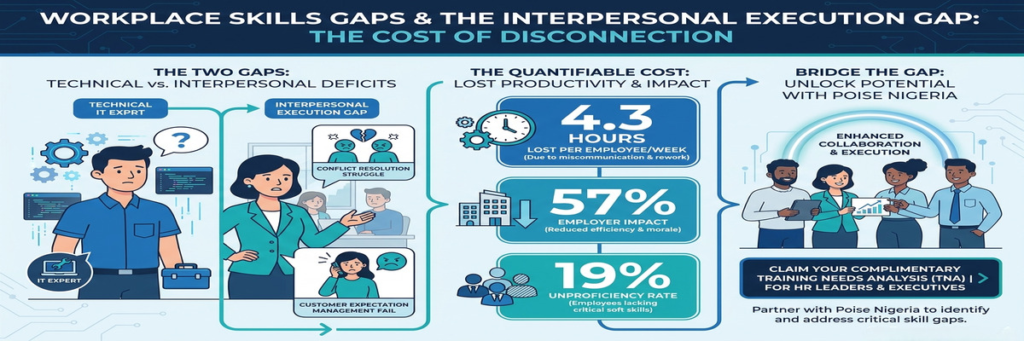
When technical personnel cannot effectively communicate complex issues to clients or navigate difficult conversations, routine service calls escalate into formal disputes. The organization suffers double friction: internal technical rework to fix field errors, and commercial friction as sales and executive teams intervene to save endangered accounts.
Training programs that focus exclusively on technical software or rigid procedures fail to solve these issues. Sustainable performance recovery requires cultivating key soft skills, including active listening, adaptive communication, professional diplomacy, and collaborative problem-solving.
4. Using Training Needs Analysis for Organizational Productivity to Drive Workforce Performance
Resolving enterprise skills gaps requires moving from reactive retraining to precise, data-driven diagnostic assessment. Organizations often waste significant training budgets on broad, generic courses that do not target the actual capability bottlenecks stifling productivity.
To bridge this gap, Executive Leadership and HR Managers must conduct a comprehensive Training Needs Analysis (TNA).
A structured TNA systematically audits current workforce capabilities against strategic operational requirements, identifying exact proficiency gaps across departments, roles, and individual employees.
3-Stage Capability Recovery Framework
- Diagnostic Assessment (TNA) : Conduct structured audit to isolate specific technical and soft skill deficits.
- Targeted Learning Interventions : Deploy tailored soft skills mastery and curated organizational courses.
- Operational Optimization : Reclaim wasted working hours, reduce rework, and eliminate customer service friction.
Improve Organizational Performance Through Training Needs Analysistrategic Value of Poise Nigeria’s Complimentary TNA Session
Skills gaps rarely resolve themselves. Left unchecked, they contribute to productivity losses, higher operating costs, employee burnout, and declining customer satisfaction.
Through a structured Training Needs Analysis for Organizational Productivity, organizations can accurately identify capability gaps, invest in targeted learning interventions, and improve workforce effectiveness.
Poise Nigeria’s complimentary Training Needs Analysis session provides HR leaders and executives with a practical framework for diagnosing workforce challenges and developing focused learning solutions that deliver measurable business results.
Session Details
Date: Thursday, November 19, 2026
Registration: https://bit.ly/poiseTNA2026
Contact: +234 706 713 6541 | +234 916 121 8002
Email: Sales@poisenigeria.org